The Complete Guide to Money and Tipping in Singapore
You have just polished off a plate of Hainanese chicken rice at a bustling Maxwell Food Centre. The uncle at the stall gives you a friendly nod. You instinctively reach for your pocket to leave a tip. Stop right there. Tipping in Singapore is not like tipping in the United States or even parts of Europe. In fact, it can sometimes be seen as awkward or unnecessary. This guide is your cheat sheet to handling money, paying bills, and navigating gratuities like a true local in 2026.
Singapore operates on a strict ‘no tipping’ policy. Gratuities are generally neither required nor expected, as most restaurants and hotels automatically include a 10% service charge and 9% GST in your bill. However, leaving small change or rounding up the fare in taxis is a nice gesture, and tipping a dollar or two for exceptional hotel service is welcomed. This guide breaks down exactly when and how to tip in Singapore so you can navigate social situations confidently and manage your travel budget effectively.
Understanding the Singapore Dollar and Payment Habits
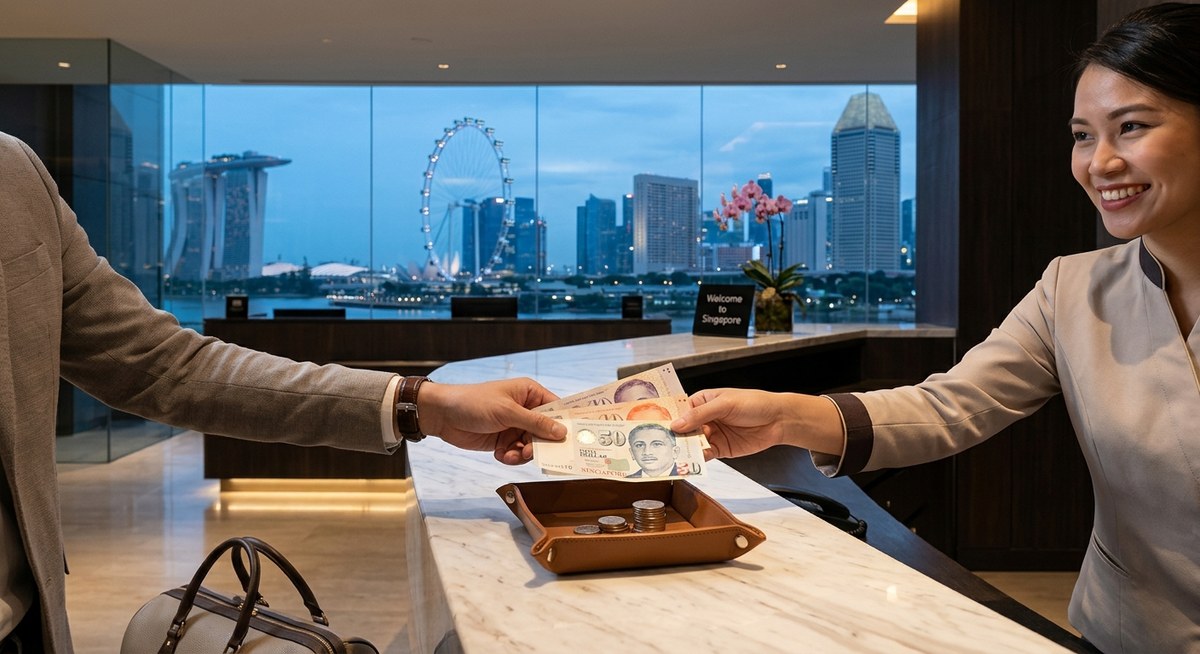
The Singapore Dollar (SGD) is the official currency. Coins come in denominations of 5, 10, 20, and 50 cents, plus the one dollar coin. Notes range from S$2 to S$10, S$50, and S$100. You will rarely see a S$1,000 note in circulation, and most shops happily accept card payments.
Here are the most common payment methods you will encounter during your trip:
- Cash (Physical Notes and Coins): Still king at hawker centres, traditional coffee shops, and some smaller taxis. Always carry a mix of small denominations.
- Credit and Debit Cards: Visa, Mastercard, and American Express are widely accepted in hotels, shopping malls, and larger restaurants.
- PayNow and QR Payment Systems: Locals love this. As a tourist, you can use apps like YouTrip, Trust Bank, or Revolut to scan SGQR codes at hawker stalls and shops.
- NETS: A local debit payment system. Most Singaporean bank cards have this. Tourists usually rely on cards or cash instead.
If you are planning a trip to Singapore, getting familiar with these options early will make your first few days much smoother.
The Simple Answer: Why Tipping is Not a Thing Here
Singapore prides itself on efficiency. The government has historically discouraged tipping because service staff earn stable, competitive salaries. The system is designed so that workers do not depend on gratuities to make a living. This means you can relax. You are not going to shortchange anyone by failing to tip.
Look closely at your bill at any sit down restaurant. You will see two lines: “10% Service Charge” and “9% GST” (Goods and Services Tax). That service charge is the built in gratuity. It goes to the restaurant, not directly to the server, but it supports the overall wage structure. This makes managing your travel expenses much easier because you already know the extra cost upfront. There is no guesswork.
A Closer Look: When Is It Okay to Tip?
While tipping is not expected, there are a few situations where leaving a little extra is seen as a gracious gesture. The key is to never feel obligated. Here is a handy table to guide you:
| Venue / Service | Is Tipping Expected? | What Locals Do |
|---|---|---|
| Fine Dining Restaurants | No (10% SC + GST included) | Round up the total bill to the nearest S$10 or S$20 if the sommelier was amazing. |
| Casual Restaurants & Cafes | No (Service charge often included) | Leave the small change from your coin purse. Usually S$0.50 to S$2. |
| Hawker Centres & Food Courts | Absolutely not (no service charge) | Nothing at all. Just enjoy your food. |
| Taxis & Ride-Hailing (Grab/GoJek) | No | Round up the metered fare. For example, S$8.80 becomes S$9 or S$10. |
| Hotel Porters / Bellboys | Not expected, but welcomed | S$2 to S$5 per bag is a kind gesture. |
| Housekeeping | Not expected, but welcomed | Leaving S$2 to S$5 per night of your stay is appreciated. |
| Private Tour Guides | Not included in base fee | S$10 to S$20 per person for a full day private tour is very generous. |
As you can see, the rule of thumb is “optional and modest”. No one will chase you down the street for a tip here.
How to Handle Money in a Taxi or Ride-Hail
Taxis in Singapore run on meters. Drivers appreciate exact change. Tipping is not built into the culture like in New York or Tokyo. If your fare comes to S$9.60 and you hand over S$10, just tell the driver to keep the change. That is the most common form of tipping here.
For ride-hailing apps like Grab or GoJek, the fare is fixed at the time of booking. You do not need to add a tip inside the app. The driver receives the full payment amount. If they help you with heavy luggage, a small cash tip of S$2 is a nice bonus, but again, it is never expected.
Tipping at Hotels and for Porters
Hotels in Singapore are world class. You will find that the service levels are exceptional regardless of whether you tip. If a bellboy takes your bags up to the room, handing them S$2 to S$5 is a polite way to say thank you.
For housekeeping, leaving a small tip (S$2 to S$5 per night) under the pillow or on the desk with a note is a nice international standard. Many guests do not do this, so your gesture will be warmly received. If you are staying at one of the best boutique hotels, the concierge might go out of their way to get you a reservation at a hot new restaurant. A token of S$10 to S$20 for that kind of effort is a classy move.
Common Mistakes Visitors Make with Money and Tipping
Avoid these common errors to keep your trip smooth and socially graceful:
- Leaving cash on the table at a hawker centre. This causes confusion. The stallholder might think you forgot your change. Just collect your money and say thank you.
- Overtipping in taxis. Do not add a 15% or 20% tip. Simply rounding up to the nearest dollar is the local standard.
- Asking to remove the service charge. You can technically ask, but it puts staff in an awkward position. The service charge is a standard part of pricing in Singapore.
- Assuming everywhere takes cards. Many hawker stalls and smaller shops are cash only or use PayNow. Without cash, you might miss out on a great meal or a local souvenir.
Expert Advice: A Local’s Perspective
“Many visitors feel guilty or obligated to tip because that is the custom back home. In Singapore, hospitality is baked into the price. The 10% service charge isn’t a suggestion; it’s the system. Our service staff are paid salaries, not tips. If you truly receive world class service, leaving a little extra is a beautiful bonus. But never feel pressured to do so. Just enjoy your meal and your stay.”
A veteran hotel manager in Orchard Road
This quote sums up the local mindset perfectly. Tipping is a bonus for extraordinary service, not a salary top up.
Navigating Service Charges and Taxes
When you dine out or book a hotel, always factor in the extra costs. A menu that lists a main course for S$30 will end up costing you around S$33 to S$35 after the 10% service charge and 9% GST are added.
Some budget eateries, especially those in industrial areas or hawker centres, do not charge a service charge at all. They simply quote the price of the food. This is why paying at a hawker centre is so straightforward. You pay the listed price, and the service is self-service.
When choosing the right accommodation, check whether the hotel includes breakfast or resort fees. Most luxury hotels in Singapore bundle these costs clearly, so you know exactly what you are paying before you check in.
Budgeting for Your Singapore Trip Without the Tipping Confusion
One of the best things about traveling to Singapore is the lack of tipping pressure. You can budget very accurately.
- Meals: Look at the menu price, add 19% (10% SC + 9% GST).
- Taxis: Budget for the metered rate plus a small rounding up.
- Hotels: Check if service charge is included (it always is).
- Activities: Prices listed are usually final.
Because you are not setting aside 15% to 20% for tips at every meal, you have more money to spend on actual experiences. That means an extra cocktail at a rooftop bar or a better seat at a show.
Final Thoughts: Enjoy the City Without the Tipping Stress
You can now walk into any restaurant, hop into any taxi, and check into any hotel with complete confidence. Tipping in Singapore is not a chore or an obligation. It is a small, optional bonus for truly outstanding service. The system is built to be fair to workers and easy for visitors.
Let go of the habit of calculating a tip in your head. Instead, focus on the flavors of the food, the beauty of the skyline, and the warmth of the people. Your wallet will thank you, and your trip will be far more relaxing for it.