Singapore’s Public Transport Masterclass: MRT, Buses, and Getting Around Efficiently
Singapore’s public transport system isn’t just efficient. It’s one of the most intuitive networks you’ll ever use. Within hours of landing, you’ll be zipping across the island like you’ve lived here for years. The Mass Rapid Transit (MRT) forms the backbone, complemented by an extensive bus network that fills every gap. Together, they create a seamless web that connects Changi Airport to Marina Bay, Orchard Road to Sentosa, and everything in between. No car rental stress. No taxi meter anxiety. Just tap, ride, and go.
Singapore’s public transport combines the MRT rail network with comprehensive bus routes, all accessible through contactless payment. Use your credit card or mobile wallet to tap in and out. Fares range from $0.90 to $2.50 for most journeys. Download the SimplyGo or TransitLink app for real-time updates. The system operates from 5:30am to midnight daily, with extended hours on weekends. Plan your route using Google Maps or the official apps for accurate timing and transfers.
Understanding the MRT network
The MRT spans six colour-coded lines that crisscross the entire island. Each line has a distinct identity. The North-South Line (red) runs from Jurong East through the city to Marina Bay. The East-West Line (green) connects Changi Airport to Tuas. The Circle Line (yellow) loops around central Singapore. The Downtown Line (blue) serves newer residential areas. The Thomson-East Coast Line (brown) is still expanding. The North-East Line (purple) links Punggol to Harbourfront.
Stations are marked with clear signage in English, Mandarin, Malay, and Tamil. Platform screen doors keep you safe. Air conditioning makes every journey comfortable. Trains arrive every 2 to 5 minutes during peak hours, 5 to 8 minutes off-peak.
Finding your way is straightforward. Station names appear on overhead displays inside trains. Electronic boards show the next station and which side the doors will open. Most interchanges have colour-coded floor markings that guide you between lines without confusion.
How to plan your MRT journey
- Open Google Maps or the MyTransport.SG app on your phone.
- Enter your destination and select the public transport option.
- Review the suggested route, noting which line to take and where to transfer.
- Check the estimated travel time and last train timing if travelling late.
- Head to the nearest MRT station and follow the directional signs to your platform.
The ultimate first-timer’s guide to navigating Singapore like a local covers broader navigation strategies that complement your transport knowledge.
Paying for your rides without hassle
Singapore eliminated the need for paper tickets years ago. You have three main payment options, all using contactless technology.
Credit or debit cards: Most international Visa, Mastercard, and American Express cards with contactless capability work. Just tap your card on the reader at the entry gantry and tap again when you exit. The system automatically calculates your fare and charges your card. No registration needed.
Mobile wallets: Apple Pay, Google Pay, and Samsung Pay function identically to physical cards. Hold your phone near the reader, authenticate if required, and you’re through.
EZ-Link or NETS FlashPay cards: These stored-value cards can be purchased at any MRT station. Load them with credit and tap to pay. Useful if you prefer not to use your bank card for small transactions.
The SimplyGo system tracks all your journeys automatically. You’ll receive a monthly statement if using a credit card, or can check your balance at any station if using a stored-value card.
“First-time visitors often worry about payment complexity. Don’t. Singapore’s transport payment is simpler than ordering coffee. Tap in, tap out, done. The system handles everything else.” – Transport veteran with 15 years of daily commuting
Mastering the bus network
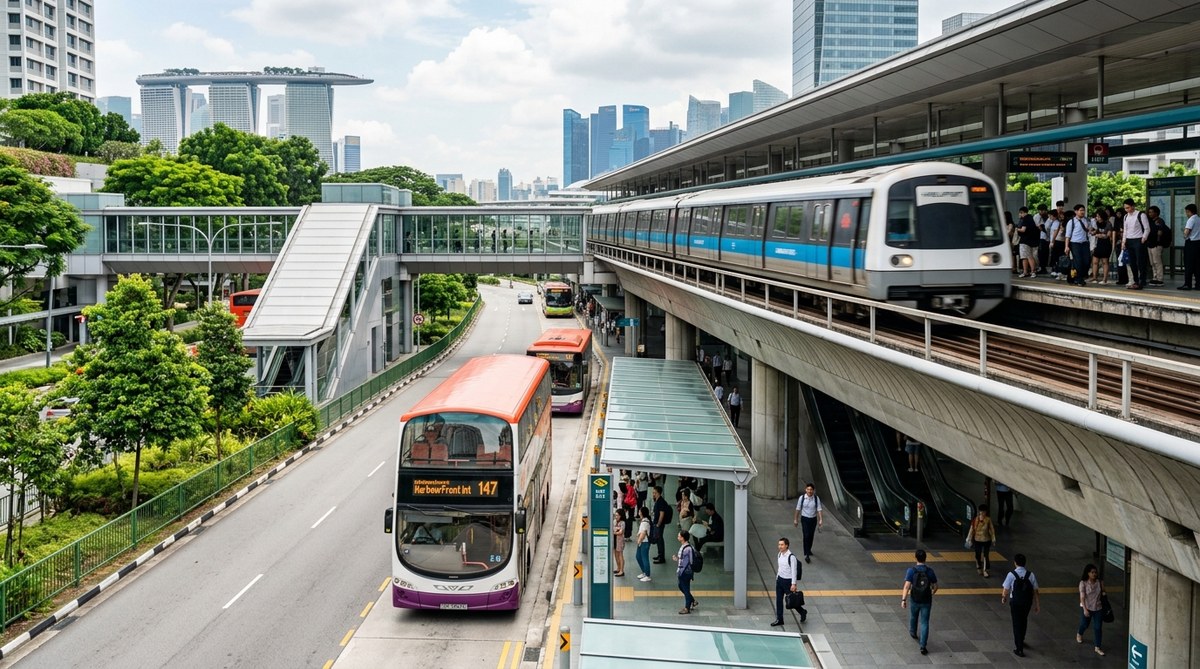
Buses complement the MRT by reaching areas the trains don’t serve. Over 300 routes operate across the island, from express services to neighbourhood feeders. Bus stops display route numbers, destinations, and estimated arrival times on electronic boards.
Boarding is simple. Enter through the front door, tap your card on the reader, find a seat, and tap again when you exit through the rear doors. Always tap out on buses. Unlike the MRT, buses calculate fares based on distance, and failing to tap out results in maximum fare charges.
Bus route numbers follow a logical pattern. Single or double-digit numbers (like 14 or 36) are trunk services connecting major areas. Three-digit numbers starting with 9 are premium express buses. Numbers ending in letters (like 171A) are route variations.
Essential bus travel tips
- Download the SG BusLens app to see which buses are approaching in real-time
- Stand behind the yellow line at bus stops to signal the driver to stop
- Priority seats near the front are reserved for elderly, pregnant, or disabled passengers
- Buses can get crowded during morning (7am to 9am) and evening (5pm to 8pm) peaks
- Night buses (prefixed with N) operate after midnight on weekends along popular routes
Understanding how much a Singapore holiday actually costs helps you budget transport expenses alongside other travel costs.
Navigating from Changi Airport
Your public transport journey begins the moment you clear immigration. Changi Airport connects directly to the MRT via Terminals 2 and 3. Follow the green MRT signs through the terminal. The station sits underground, about a 5-minute walk from baggage claim.
The East-West Line runs from Changi Airport to the city. Journey time to Raffles Place is approximately 35 minutes. To reach Orchard Road, transfer at Tanah Merah to the westbound train, then change again at City Hall to the North-South Line.
Bus services also operate from all terminals. Route 36 travels to Orchard Road and Marina Bay. Route 24 serves the east coast. Route 27 heads to Tampines and Hougang. Buses cost less than the MRT but take longer due to traffic.
Late arrivals can use taxis or ride-hailing services from the designated pickup points. Fares to the city range from $20 to $35 depending on time and destination.
Choosing between MRT and buses strategically
Each mode suits different situations. The MRT wins for speed and reliability. Buses offer scenic routes and reach specific addresses the trains miss. Knowing when to use each saves time and enhances your experience.
| Situation | Best Choice | Reason |
|---|---|---|
| Airport to hotel | MRT | Fastest, no traffic delays |
| Orchard Road to Marina Bay | MRT | Direct connection, 10 minutes |
| Exploring neighbourhood streets | Bus | Reaches specific addresses |
| Late night travel after midnight | Taxi or ride-hailing | Public transport stops running |
| Travelling with heavy luggage | MRT | Lifts at all stations, no stairs |
| Rainy weather | MRT | Underground stations stay dry |
| Sightseeing along the route | Bus | Upper deck views on double-deckers |
The guide to choosing between Marina Bay and Orchard Road hotels helps you pick accommodation near transport hubs.
Timing your journeys around peak hours
Singapore’s public transport gets noticeably busier during morning and evening peaks. Trains fill up. Buses take longer. Stations get crowded. If your schedule allows flexibility, travel between 10am and 4pm or after 8pm for a more comfortable experience.
Peak periods run from 7am to 9am and 5pm to 8pm on weekdays. Weekend mornings are quieter, but popular destinations like Orchard Road and Marina Bay see crowds from 11am onwards.
The MRT extends operating hours on Fridays, Saturdays, and eve of public holidays. Last trains depart around 1am instead of the usual midnight. Check the TransitLink app for exact timings on your specific route.
Getting to popular attractions efficiently
Most major attractions sit within walking distance of MRT stations. Marina Bay Sands, Gardens by the Bay, and the Merlion are all accessible from Bayfront or Marina Bay stations. Sentosa connects via Harbourfront station, where you can board the Sentosa Express monorail.
Orchard Road shopping spans three stations: Somerset, Orchard, and Newton. Each station serves different mall clusters. Universal Studios and S.E.A. Aquarium require the MRT to Harbourfront, then the Sentosa Express or bus.
Chinatown has its own station on the North-East Line. Little India station serves the vibrant ethnic quarter. Arab Street and Haji Lane are a short walk from Bugis station. The Singapore Zoo, Night Safari, and River Wonders connect via the North-South Line to Ang Mo Kio, then bus 138.
Those interested in local dining should read about hawker centres where locals actually eat to plan food stops along your transport route.
Understanding fare structures and daily caps
MRT and bus fares depend on distance travelled. Shorter journeys cost around $0.90 to $1.20. Longer cross-island trips reach $2.00 to $2.50. Transfers between MRT and bus within 45 minutes receive a small discount.
SimplyGo automatically applies daily fare caps. Once your spending reaches $9.60 in a day (Monday to Saturday) or $6.40 on Sundays and public holidays, all subsequent rides are free. This protects you from overspending if you’re making multiple journeys.
Children under 7 ride free. Students and seniors receive concessionary fares but need a special card. Tourists don’t qualify for these discounts, so standard adult fares apply.
Handling common transport challenges
Missed your stop: Stay calm. Exit at the next station and take a train back. No additional charge if you complete your journey within the same trip.
Card declined: Some international cards don’t support Singapore’s contactless system. Buy an EZ-Link card from the ticket machine as backup.
Lost or confused: Station staff at the passenger service counter speak English and can provide directions. They’re genuinely helpful.
Forgot to tap out: You’ll be charged the maximum fare for that line. Tap in and out properly on your next journey to reset your card’s status.
Phone battery died: If using mobile payment, carry a physical card as backup. Station ticket machines don’t accept cash anymore, but you can use your credit card to buy an EZ-Link card.
Using transport apps effectively
Three apps make navigating Singapore’s transport network effortless. MyTransport.SG provides official route planning and real-time train arrival information. Google Maps integrates public transport directions seamlessly. SG BusLens uses augmented reality to show which buses are approaching your stop.
Download these essential Singapore travel apps before your trip for maximum convenience.
Set up your payment method before your first journey. Add your contactless card to your phone’s wallet app. Test it once to ensure it works. This eliminates fumbling at the gantry while other passengers wait behind you.
Travelling with luggage and special needs
All MRT stations have lifts connecting street level to platforms. Look for the lift icon on station maps. Some older stations have lifts that don’t reach every level directly, requiring you to take two separate lifts with a short walk between.
Trains have designated wheelchair spaces and priority seats. Buses feature low floors and ramps that deploy at stops. Drivers will assist if you need help boarding.
Large luggage is permitted on trains and buses. Travel outside peak hours if possible to avoid inconveniencing other passengers. Keep bags close to avoid blocking aisles or doors.
Families with strollers find the MRT more manageable than buses. The spacious trains and level boarding make movement easier. Buses require folding strollers during crowded periods.
Extending your reach with integrated transport
The MRT and buses form just part of Singapore’s integrated network. The Light Rail Transit (LRT) serves residential estates in Bukit Panjang, Sengkang, and Punggol. These smaller trains connect to MRT interchanges.
Bike-sharing services operate near many stations. Scan a bike using the operator’s app, ride to your destination, and park at designated zones. Useful for covering the last kilometre between stations and your final destination.
Walking paths connect many stations to nearby attractions. Covered walkways protect you from rain and sun. Singapore’s compact size means many destinations are closer than they appear on maps.
Planning day trips using public transport
Sentosa Island offers beaches, attractions, and resorts accessible via MRT and Sentosa Express. The journey from Orchard Road takes about 30 minutes. Pulau Ubin, a rustic island, requires the MRT to Tanah Merah, then bus 2 to Changi Point Ferry Terminal.
The Southern Ridges walking trail starts near Harbourfront MRT. MacRitchie Reservoir connects via bus from Marymount or Caldecott stations. East Coast Park is reachable by bus from multiple MRT stations along the East-West Line.
Day trips to Johor Bahru in Malaysia start from Kranji MRT, where you can catch a bus to the Woodlands Checkpoint. The entire journey takes about 90 minutes, including immigration clearance.
Avoiding rookie mistakes
Common errors slow you down and cost extra money. Learn from others’ missteps.
- Tapping someone else’s card: Each person needs their own card or payment method. Tapping once for two people charges the maximum fare.
- Standing on the wrong side of escalators: Stand on the left, walk on the right. Locals get frustrated when tourists block the walking lane.
- Forgetting to check last train times: Missing the last train means expensive taxi rides. Check timings before heading out for dinner or drinks.
- Assuming buses stop automatically: You must press the bell or the driver won’t stop at every station.
- Not having backup payment: If your main card fails, you’re stuck buying a stored-value card at premium rates.
Those planning evening entertainment should explore Singapore’s best rooftop bars and factor in last train timings.
Dealing with Singapore’s weather while commuting
Rain happens frequently, often without warning. MRT stations keep you dry, but walking between stations and your destination exposes you to downpours. Carry a compact umbrella always.
The heat and humidity make waiting at outdoor bus stops uncomfortable. Many stops have shelters, but not all. Plan bus journeys during cooler morning hours when possible. The MRT’s air conditioning provides consistent comfort regardless of outdoor conditions.
Understanding Singapore’s weather and what to pack helps you dress appropriately for transport journeys.
Making transport work with your accommodation
Choosing a hotel near an MRT station transforms your entire trip. You’ll spend less time travelling and more time enjoying Singapore. Orchard Road, Marina Bay, and Chinatown offer excellent hotel options with direct station access.
The guide to family-friendly hotels highlights properties near transport hubs suitable for travelling with children.
Some boutique hotels in neighbourhoods like Tiong Bahru sit slightly further from stations but offer authentic local experiences. A 10-minute walk to the MRT becomes part of your daily routine, letting you see residential Singapore beyond tourist zones.
Your first journey sets the tone
Your initial experience with Singapore’s public transport shapes your entire visit. Take it slow. Follow the signs. Watch what locals do. Within a day, you’ll navigate with confidence. Within two days, you’ll wonder why transport in other cities feels so complicated.
The system works because it’s designed for humans, not bureaucrats. Clear signage. Logical routes. Fair pricing. Reliable timing. Everything functions as it should. Your job is simply to tap your card, board your train or bus, and enjoy the ride. Singapore’s transport network doesn’t just move you from place to place. It connects you to the city’s rhythm, its people, and its neighbourhoods in ways that taxis and private cars never could.
Start with simple journeys. Airport to hotel. Hotel to Marina Bay. Hotel to Orchard Road. Build your confidence with each trip. Soon you’ll be planning complex routes across multiple lines, timing your transfers, and arriving exactly when you intended. That’s when Singapore truly opens up.